Annapurna Circuit vs Annapurna Base Camp: Which Trek Should You Do?
Choose the Annapurna Circuit if you have 2 to 3 weeks and want maximum variety. Choose ABC if you have about 2 weeks and want to stand inside a high mountain amphitheatre. The Circuit is longer (15 to 21 days), harder, and crosses a 5,416m pass. ABC is shorter (10 to 14 days), moderate, and reaches 4,130m.
Both trek in the Annapurna Conservation Area and require the applicable ACAP entry permit and current trekking documentation. Both can be combined in a single 3 to 4 week trip. The decision usually comes down to time and what kind of experience you are after.
Annapurna Circuit vs ABC: Quick Facts
- Circuit duration: 15 to 21 days (MountainKick: 16-day standard or 21-day Classical)
- ABC duration: 10 to 14 days depending on itinerary (MountainKick: 14 days)
- Circuit highest point: Thorong La Pass at 5,416m
- ABC highest point: Annapurna Base Camp at 4,130m
- Circuit difficulty: Challenging, prior trekking experience recommended
- ABC difficulty: Moderate, suits first-time trekkers
- Circuit package from: USD 770 for 2 to 3 people, USD 643 for groups of 4 to 7 (MountainKick 16-day)
- ABC package from: USD 760 for groups of 4 to 9 (MountainKick 14-day)
- Permits (both): ACAP plus current trekking documentation. See our permits guide
- Best time (both): March to May and September to November
Both treks are in the Annapurna region of Nepal, both are excellent, and both are regularly recommended to first-time Nepal trekkers. But they are very different journeys in length, difficulty, scenery and what they are good for.
The Annapurna Circuit circumnavigates the entire Annapurna massif over 15 to 21 days, crossing the 5,416m Thorong La Pass and passing through the Kali Gandaki Gorge and the high-altitude desert of Manang. The Annapurna Base Camp trek goes straight into the glacial amphitheatre at the foot of Annapurna I, takes 10 to 14 days depending on itinerary, and does not cross any high passes.
This guide covers the practical differences in terrain, altitude, cost, best time and what kind of trekker each one suits, so you can make a clear decision.
Quick Comparison: Annapurna Circuit vs ABC
| Annapurna Circuit | Annapurna Base Camp (ABC) | |
|---|---|---|
| Duration | 15 to 21 days | 10 to 14 days |
| Difficulty | Challenging | Moderate |
| Highest point | Thorong La Pass, 5,416m | Annapurna Base Camp, 4,130m |
| Route style | Loop (around the massif) | In-and-out (to the Sanctuary) |
| Scenery | Diverse: forest, alpine and arid desert | Focused: deep gorge to mountain amphitheatre |
| Culture | Gurung, Manangi, Thakali, Tibetan Buddhist | Primarily Gurung villages |
| High pass crossing | Yes, Thorong La (5,416m) | No |
| Package from (MountainKick) | USD 643 for groups of 4 to 7 (16-day), from USD 827 (21-day) | USD 760 for groups of 4 to 9 |
| Best season | March to May, September to November | March to May, September to November |
| Permits | ACAP + current trekking documentation | ACAP + current trekking documentation |
Annapurna Circuit: What to Expect

The Annapurna Circuit is a loop trek that goes around the entire Annapurna massif. You start in the low subtropical valleys around Besisahar or Bhulbhule, climb steadily through Chame, Pisang, and Manang, cross the Thorong La Pass at 5,416m, descend steeply to Muktinath, and then follow the Kali Gandaki Gorge south through Jomsom and Tatopani before ending near Pokhara.
The landscape changes dramatically as you go. The first few days are green, warm and lush, with bamboo, rice paddies and rhododendron forest. By the time you reach Manang at 3,519m, the terrain has shifted to high-altitude semi-desert with views of Gangapurna, Annapurna III, and Tilicho Peak. Crossing Thorong La and descending to Muktinath takes you into territory that feels more like Tibet than Nepal: arid, windswept and remote. The Kali Gandaki Gorge is one of the world’s most dramatic deep mountain valleys, lying between Annapurna (8,091m) and Dhaulagiri (8,167m).
The cultural variety is a major part of what makes the Circuit worth doing. You pass through Gurung villages in the lower sections, Manangi communities in the middle, who have a long history as traders with Tibet, and Thakali towns in the Kali Gandaki, each with distinct architecture, food, and customs. Muktinath is a significant pilgrimage site for both Hindus and Buddhists.
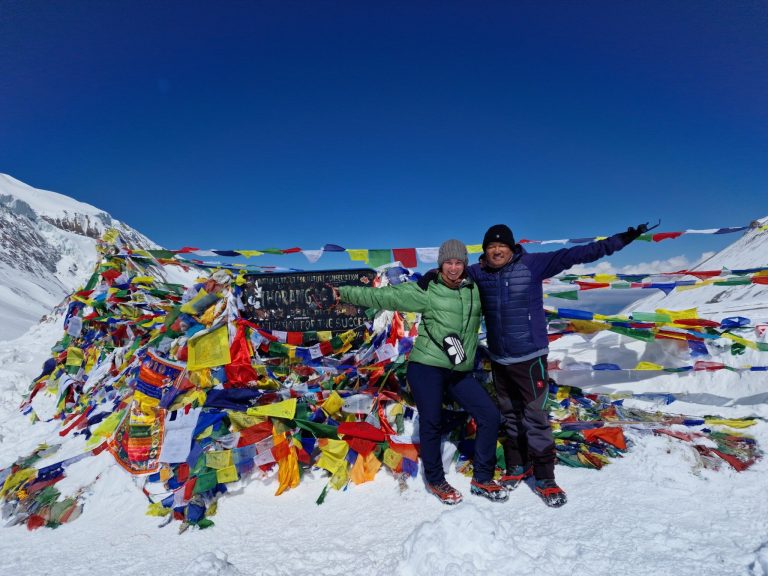
The Thorong La crossing is the crux of the trek. Most trekkers start from Thorong Phedi or High Camp at 3 to 4am to reach the pass (5,416m) and descend the long steep section to Muktinath before afternoon winds pick up. Proper acclimatisation in Manang is essential. Read our altitude sickness guide before attempting this route.
Difficulty: Challenging
Highest point: Thorong La Pass, 5,416m / 17,769ft
Best season: March to May, September to November
Permits: ACAP + current trekking documentation, included in package
Start/end: Besisahar or Bhulbhule to Nayapul or Jomsom
MountainKick offers two versions: the 16-day Annapurna Circuit from USD 643 (uses vehicle support on road-affected lower sections) and the 21-day Classical Trek from USD 827 (every kilometre on foot). For the full cost breakdown see our Annapurna Circuit cost guide.
Annapurna Base Camp: What to Expect

The ABC trek follows the Modi Khola river valley from the lowlands near Pokhara up through a progressively narrowing gorge into the Annapurna Sanctuary, a high glacial basin completely encircled by peaks above 6,000m, including Annapurna I (8,091m), Annapurna South, Machapuchare (Fishtail, 6,993m), and Hiunchuli. You finish at Annapurna Base Camp itself at 4,130m, where the peaks surround you on all sides.
The approach is different in character from the Circuit. You move quickly from subtropical forest and terraced rice paddies in Ghandruk and Chhomrong into rhododendron forest, then bamboo, then the narrow upper gorge where the trail squeezes between steep valley walls before opening suddenly into the Sanctuary. The transition from the gorge into the open basin is one of the more dramatic moments in Nepal trekking. You go from enclosed forest to a 360-degree ring of Himalayan giants in the space of a few steps.
Poon Hill (3,210m) is often included as an early addition, either at the start or during the return. The sunrise from Poon Hill over the Annapurna and Dhaulagiri ranges is one of the most photographed views in Nepal, and it is a relatively easy 1 to 2 hour climb from Ghorepani. Most ABC itineraries can build this in without significantly adding to the overall difficulty.
There is no high pass on this route. The main altitude challenge is Base Camp at 4,130m. Acclimatisation is still important, but the shorter duration and lower maximum altitude make AMS less of a concern than on the Circuit.
Difficulty: Moderate
Highest point: Annapurna Base Camp, 4,130m / 13,550ft
Best season: March to May, September to November
Permits: ACAP + current trekking documentation, included in package
Start/end: Nayapul or Phedi near Pokhara, returning the same way or via Poon Hill
See the ABC Trek itinerary and our full Annapurna Base Camp cost guide for a complete breakdown.
Cost Comparison: Circuit vs ABC
Both treks require the same type of permit, an ACAP entry permit plus current trekking documentation, so permit requirements are broadly equal. The main cost driver is duration: the Circuit runs 15 to 21 days versus 10 to 14 for ABC, which means more spending on accommodation, meals, and guide fees if trekking independently.
The table below separates typical independent-trekking costs from MountainKick package pricing, since a package bundles accommodation, meals, and guide fees into one price.
| Cost item | Annapurna Circuit | ABC Trek |
|---|---|---|
| Permits (ACAP + documentation) | See permits guide | See permits guide |
| Teahouse accommodation (independent) | USD 5 to 15 per night x 15 to 21 nights | USD 5 to 15 per night x 10 to 14 nights |
| Meals on trek (independent) | USD 20 to 35 per day | USD 20 to 35 per day |
| Licensed guide (if trekking independently) | USD 30 to 40 per day | USD 30 to 40 per day |
| MountainKick package from | USD 643 for groups of 4 to 7 (16-day), with guide, permits and meals included | USD 760 for groups of 4 to 9, with guide, permits and meals included |
The Annapurna Circuit and ABC are routes where foreign trekkers must follow the current guide and TIMS requirements. See our Nepal trekking permits guide for the current rules. Guide fees are included in all MountainKick packages, so you will not need to arrange this separately. For the full cost breakdown see our Annapurna Base Camp Trek Cost 2026 guide and our Annapurna Circuit Trek Cost 2026 guide.
Difficulty and Fitness
Annapurna Circuit is challenging primarily because of the Thorong La crossing at 5,416m and the overall duration. You need to be comfortable walking 5 to 7 hours daily for 15 to 21 consecutive days, with several days above 4,000m. Prior trekking experience is strongly recommended. Cardiovascular fitness matters more than technical skill. The trail requires no ropes or climbing equipment, but the pass crossing is physically demanding and altitude sickness is a genuine risk.
ABC Trek is moderate and accessible to first-time trekkers in good physical condition. The daily ascents and descents can be steep, particularly around Chhomrong and through the gorge. But the maximum altitude of 4,130m is manageable for most people with proper acclimatisation pacing. If you can comfortably walk 4 to 6 hours a day and have reasonable fitness, ABC is achievable without prior trekking experience.
For both treks, read our altitude sickness guide before departure and ensure you have travel insurance that covers helicopter evacuation.
Can You Do Both Treks?

Yes, and it is a popular option for trekkers with 3 to 4 weeks in Nepal. The most common combination is doing the Annapurna Circuit first, then branching off near Chhomrong or Sinuwa to enter the Sanctuary and reach Base Camp before returning to Pokhara. This adds 4 to 6 days to the Circuit itinerary and gives you both the diversity of the full loop and the close-up mountain experience of the Sanctuary.
The other common variation is ABC plus Poon Hill, which fits into 9 to 12 days and gives strong mountain views from two different vantage points without committing to the full Circuit. Poon Hill (3,210m) can be added to some ABC itineraries, depending on the route and available time, and is widely considered one of the best viewpoints in the Annapurna region.
MountainKick can build a combined itinerary around your available time. Get in touch with your dates and we will put together the options.
Which Trek Is Right for You?
- You have 2 to 3 weeks in Nepal
- You want maximum landscape and cultural variety in a single trek
- You want the experience of crossing a significant high pass
- You have done some trekking before and are comfortable at altitude
- You want to cover more ground rather than go deep into one area
- You have about 2 weeks in Nepal
- You want to stand inside a high Himalayan amphitheatre surrounded by 8,000m peaks
- You prefer a focused, immersive experience over a broad loop
- You are a first-time trekker or want a moderately challenging route
- You want strong mountain views without a high pass crossing
- You have 3 to 4 weeks and want the definitive Annapurna experience
- You are happy to extend the Circuit with the ABC side trip
Frequently Asked Questions
Which trek has better mountain views, Circuit or ABC?
Different rather than better. ABC puts you inside the Sanctuary, completely surrounded by peaks. The views are close-up, dramatic and enclosed. The Circuit gives you wider panoramic views of several ranges from different angles over a longer period, including the views from Thorong La. If you want to feel surrounded by mountains, choose ABC. If you want variety and changing perspectives, choose the Circuit.
Is the Annapurna Circuit still worth doing given the road construction?
Yes, though the lower sections have changed. Jeep roads now run through parts of the lower Circuit that used to be walking-only, and many trekkers skip these sections by vehicle. The upper sections, including Manang, Thorong La, Muktinath and the Kali Gandaki, are unaffected and remain excellent. Most current Circuit itineraries start higher up to avoid the road sections entirely. Read our full Manaslu Circuit vs Annapurna Circuit comparison for more on this issue.
Which trek is better in spring vs autumn?
Both are good in spring (March to May) and autumn (September to November). Spring brings rhododendron blooms on ABC and clearer skies before the pre-monsoon haze. Autumn offers the most stable, clear weather on both routes. The Circuit’s Thorong La can be snow-bound in winter (December to February) and the pass is occasionally closed after heavy snowfall. ABC at 4,130m is lower and less affected by winter conditions.
Do I need a guide for both treks?
Yes. The Annapurna Circuit and ABC are routes where foreign trekkers must follow the current guide and TIMS requirements. All MountainKick packages include a licensed guide as standard. See our Nepal trekking permits guide for full details.
How far in advance should I book?
For October (peak autumn season), 3 to 4 months in advance is recommended as teahouses and guides book up. For spring and other months, 4 to 6 weeks is usually sufficient. Contact us with your dates and we will confirm availability.
How much does each trek cost in total?
For a group of four or more, the 16-day Annapurna Circuit starts from USD 643 and ABC from USD 760. For 2 to 3 people the Circuit is USD 770. Both cover guide, permits and meals on trek. International flights, visa, insurance and personal spending are extra. For the full trekking cost breakdown see our dedicated guides: Circuit cost and ABC cost.
Not sure which one is right for you?
Send us your available dates, fitness background, and what you are hoping to get from the trek. We will give you an honest recommendation and a full cost breakdown within a few hours.
WhatsApp: +977 985 118 2718
or use our enquiry form.
Further Reading
- Annapurna Circuit Trek Cost 2026: Complete Breakdown
- Annapurna Base Camp Trek Cost 2026: The Complete Breakdown
- Manaslu Circuit vs Annapurna Circuit 2026: Which Trek Is Right for You?
- Annapurna Circuit vs EBC: Which Trek Should You Do?
- Mardi Himal Trek: The Annapurna View Most People Never See
- Nepal Trekking Permits 2026: Costs, Rules and What’s Changed
- Travel Insurance for Nepal: What Your Policy Must Cover
- Altitude Sickness on Nepal Treks: Symptoms, Prevention and What to Do
- Trekking in Nepal: The Complete Guide 2026
- How to Choose a Nepal Trekking Company